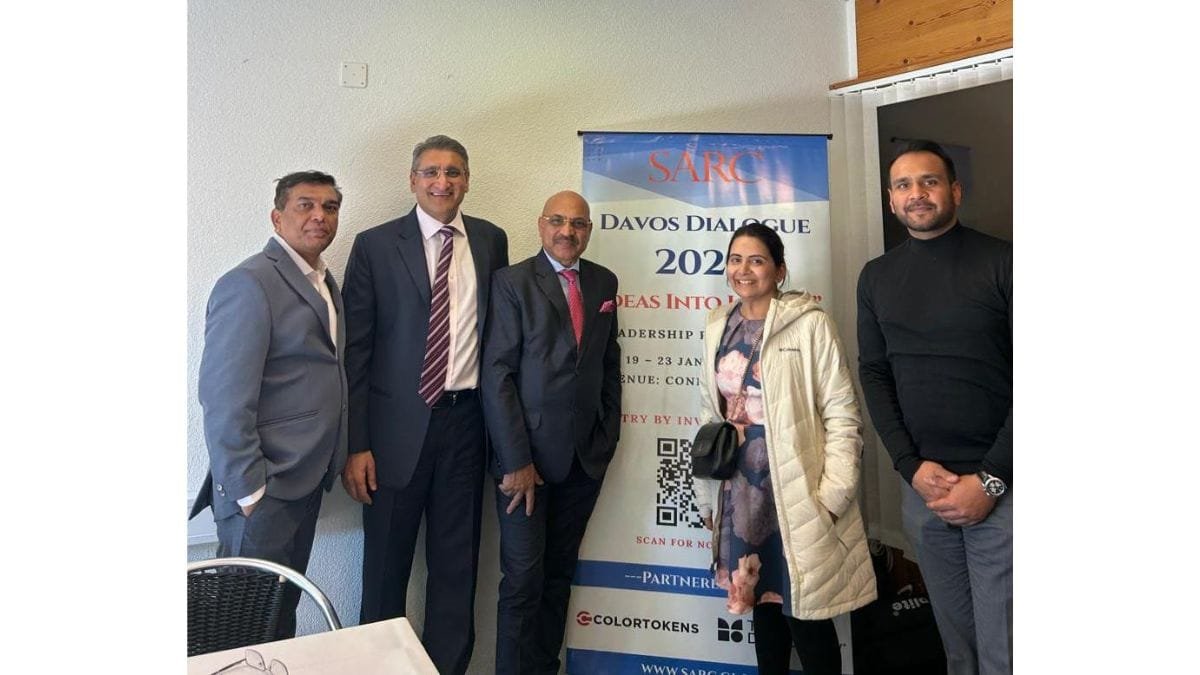
Left to right: Rajendra Bagade, Sr. Partner Sarc Global, Balbir Singh, Sr. Advocate, Supreme Court of India, Sunil Kumar Gupta, Founder & Global Leader, SARC Global , Tripti Somani, Investor, Ranu Gupta, CEO & Co-Founder, Sarc Global
New Delhi [India], January 31: SARC convened a series of high-impact roundtables showcasing an end-to-end solution for state-level data management through DataOS®, developed by The Modern Data Company (TMDC). The discussions demonstrated how integrated data architectures can strengthen public finance management, improve scheme execution and monitoring, enable real-time, data-driven decision-making, and significantly reduce operational friction across departments—thereby accelerating governance outcomes.
In partnership with ColorTokens, SARC also presented Zero-Trust–based micro-segmentation and breach-containment cybersecurity frameworks, critically relevant for data centres, cloud infrastructure, OT/SCADA systems, and government digital platforms. This approach underscored the imperative of securing digital public infrastructure as a foundational pillar of India’s journey towards Viksit Bharat @2047.
The SARC Davos Dialogues 2026 culminated in a strong reaffirmation of India’s state-led development paradigm, positioning governance—innovative, accountable, and execution-oriented—at the core of the national vision for Viksit Bharat @2047. The deliberations crystallised a defining insight: the transition from aspiration to achievement is shaped not merely by policy articulation, but by disciplined execution, institutional resilience, and administrative agility at the state level. Through a series of high-level engagements, SARC highlighted how Indian states are architecting frameworks of fiscal prudence, data-enabled governance, and regulatory coherence to translate national ambition into measurable and enduring societal outcomes.
Strengthening State Governance for Inclusive National Progress
At SARC Davos Dialogues 2026, Uttar Pradesh and Telangana took centre stage as exemplars of India’s state-driven approach to achieving Viksit Bharat @2047.
SARC Davos Dialogue: Uttar Pradesh as a National Growth Engine: Viksit UP @ 2047
The SARC Davos Dialogues advanced a forward-looking conversation on Viksit Uttar Pradesh @2047 through an in-depth engagement across the roundtable.
The dialogue focused on the state’s roadmap for the coming decades—positioning infrastructure-led growth, industrial expansion, and integrated urban–rural development as the central pillars of Uttar Pradesh’s economic transformation. Representatives of TMDC and ColorTokens, Saurabh Gupta, Chief Revenue & Strategy Officer, TMDC, Washington DC; Sagar Paul, SVP – Enterprise Sales & Solutions, TMDC, New York City; and Rajesh Khazanchi, Co-Founder & Chief Executive Officer, ColorTokens, Palo Alto, California attended the SARC Davos Dialogue Round Table, to present their DataOS and ColorTokens products before the State.
The discussion emphasised strengthening state capacity through disciplined execution, data-driven decision-making, and fiscal prudence as critical enablers of scale and sustainability. With a clear focus on accelerating project delivery, deepening institutional capability, and improving service outcomes, Uttar Pradesh is shaping a development model that moves beyond intent to impact. The deliberations concluded with a shared conviction: Viksit Uttar Pradesh is not merely a regional aspiration, but a national imperative—one that will decisively influence India’s journey to Viksit Bharat @2047.
The roundtable featured a high-level engagement between Sunil Kumar Gupta, Chairman & Global Leader, SARC, and Manoj Kumar, Chief Executive Officer, Uttar Pradesh State Transformation Commission (STC). The discussion was further enriched by strategic perspectives from Ranu Gupta, Co-founder & CEO, SARC Global; Rajendra S. Bagade, Senior Partner, SARC Global; and Probir Roy, Global Lead – Fintech, Gaming & Frontier Technologies, SARC Global, alongside industry leaders including Saurabh Gupta, Chief Revenue & Strategy Officer, TMDC, Washington DC; Sagar Paul, SVP – Enterprise Sales & Solutions, TMDC, New York City; and Rajesh Khazanchi, Co-Founder & Chief Executive Officer, ColorTokens, Palo Alto, California.
The dialogues underscored a paradigm shift: “Governance is no longer a matter of incremental reform, but a science of outcome-oriented, technology-empowered administration.” Another phase of discussion held with Telangana
State Capacity and Long-Term Growth: Telangana in the Viksit Bharat @ 2047 Journey
While infrastructure lays the foundations of growth, Telangana is building the human capital that sustains it.” – Sunil Kumar Gupta, Chairman & Global Leader, SARC.
At the Dialogue, D. Shridhar Babu, Minister for Information Technology, Electronics, Communications, Industries and Commerce & ,Sai Krishna, IT Advisor to the Hon’ble Minister for IT, Electronics, Communications, Industries & Commerce, Government of Telangana, along with SARC Global, DataOS & ColorTokens outlined the state’s human-centric pathway to Viksit Telangana @2047—one that places skills, employment, and social upliftment at the core of long-term economic transformation.
Sunil Kumar Gupta noted that the dialogue positioned skill development as Telangana’s foremost instrument for transforming unemployment into productive employment, aligning talent pipelines with emerging industries and technology-led growth. Looking ahead, discussions underscored targeted measures to uplift the economically marginalised through improved last-mile delivery, outcome-based welfare programmes, and expanded access to livelihoods. Agriculture was highlighted not merely as a sector, but as a stabilising social and economic foundation—strengthened through innovation, timely payments, climate-responsive practices, and data-enabled governance. The deliberations concluded with a shared conviction: Viksit Telangana will be defined by empowered citizens, resilient livelihoods, and inclusive growth—making the state an essential pillar of India’s Viksit Bharat @2047 journey.
Both the dialogues also underscored the centrality of trusted data and cyber resilience in enabling next-generation state governance. TMDC’s DataOS® was positioned as a foundational data and AI operating layer for government—capable of unifying fragmented data ecosystems, enabling real-time, outcome-driven decision-making, and embedding regulatory-grade governance across departments without disrupting existing infrastructure. Complementing this, ColorTokens highlighted the imperative of zero-trust cybersecurity architectures to safeguard critical state platforms, digital public infrastructure, and citizen data against escalating cyber threats. Together, the convergence of governed data, AI-readiness, and resilient cybersecurity was framed as indispensable to scaling digital governance, protecting public trust, and ensuring that technology-led transformation remains secure, compliant, and sustainable across India’s states.
Delivering on Promise: Governance, Accountability, and Viksit Bharat @2047
As the curtains fall on the SARC Davos Dialogues 2026, one truth emerges with crystalline clarity: India’s ascent to Viksit Bharat @2047 is neither abstract nor inevitable—it is the product of deliberate, disciplined, and data-empowered governance, executed state by state, institution by institution, and outcome by outcome. SARC Davos Dialogue successfully organised the Leadership Roundtables and discussions on: Capital in a Fractured World, Strategic Autonomy vs Global Interdependence, Trade, Sanctions, and the Shadow Economy, India as the Next Supply-Chain Operating System, Competitive Federalism: Which Indian States Will Win the Next Decade?, Regulatory Certainty as a Growth Asset, Uttar Pradesh as a National Growth Engine: Viksit UP @ 2047 and State Capacity and Long-Term Growth: Telangana in the Viksit Bharat @ 2047 Journey. The dialogues reaffirmed that governance today is no longer confined to policy formulation—it is an exercise in precision, accountability, and real-time decision-making.
Across five enriching days, SARC Global convened and led all roundtable discussions at the SARC Davos Dialogues 2026, bringing together visionary policymakers, industry leaders, and global experts. Discussions spanned global capital allocation, examining how long-term investments navigate geopolitical uncertainty, and strategic autonomy, exploring how resilience can be maintained without sacrificing growth.
Sessions addressed the impact of trade and sanctions and the dynamics of the shadow economy, highlighting opportunities for Indian exporters. The Dialogue also focused on India’s supply-chain advantage, assessing state-level ecosystems, approvals, and manufacturing entry points, alongside state-level competitiveness in attracting investment. Central to these conversations was the role of regulatory certainty as a growth asset, with SARC providing investment clarity and demonstrating its thought leadership in strategy, governance, and execution.
In synthesising strategy, technology, and leadership, the SARC Davos Dialogues 2026 have moved beyond reflection to prescription—articulating a credible roadmap for India’s next phase of development. State by state, institution by institution, and outcome by outcome, the foundations of Viksit Bharat @2047 are being laid—decisively, deliberately, and with enduring purpose.
If you object to the content of this press release, please notify us at [email protected]. We will respond and rectify the situation within 24 hours.